
WE DO NOT GUARANTEE PUBLICATIONS, NOR SELL PUBLICATIONS. The paper written as assignment is students' intellectual property, and it is up to them to submit for publication or not.

PRISMA Flow Diagram 2020

Understanding PRISMA Flow Diagram 2020

When writing a systematic review and meta-analysis, researchers must adhere to the Preferred Reporting Items for Systematic Reviews and Meta-Analyses (PRISMA) checklist. The PRISMA statement, published in 2009, assists researchers in reporting the rationale, methods, and findings of their reviews. Moreover, in the results section, it is essential to include the PRISMA Flow Diagram 2020, which visually represents the process of identifying relevant published data and determining their inclusion in the review. This diagram allows readers to easily comprehend the number of studies screened and included, enhancing the reporting quality of systematic reviews and meta-analyses.

You are required to draw the PRISMA flow diagram in the results part of your systematic review. The flow diagram or flow chart shows the process you used to find published data on the topic and how you decided whether to include it in the review.

Through the PRISMA diagram, the reader can easily see how many studies were screened, how many were included, and what exclusion method the author used. The main aim of the PRISMA diagram is to help writers improve the reporting of systematic reviews and meta-analyses.

Stages of PRISMA Flow Diagram

All the work described in the PRISMA diagram is categorized into four stages:

  • Identification- stage one is identifying the articles for review
  • Screening- this stage includes screening the articles for review
  • Eligibility- this step involves deciding on the eligibility of the studies
  • Inclusion- the last step is finalizing the list of studies to include in your systematic review

To complete the PRISMA diagram, download/save a copy of it from the PRISMA Website to use alongside your searches.

Let us have a look at the important terminologies used in the PRISMA 2020 flow chart

Report

It is a document- paper or electronic providing information about a certain study. It may be a clinical study report, a journal article, an unpublished manuscript, or any other document supplying relevant information.

Record

The title or abstract of a report indexed in a database or website. For instance, a title or abstract for an article indexed in Medline is a record. Records that refer to the same report are duplicates.

Study

An investigation such as a clinical trial that includes a defined group of participants and one or more interventions and outcomes. A study might have multiple reports. For instance, reports could be a statistical analysis plan, baseline characteristics, results for primary and secondary outcomes, results for harms, and so on.
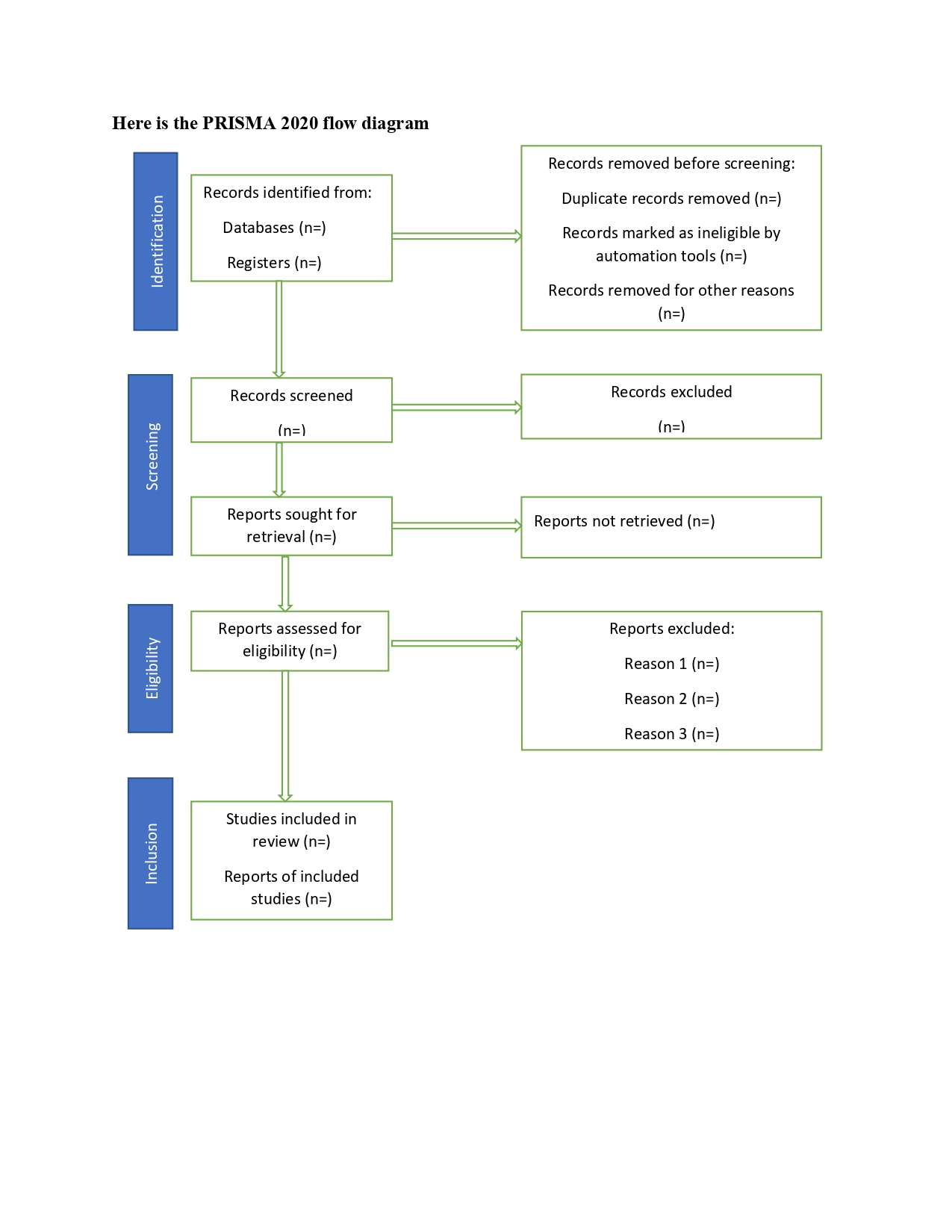
PRISMA 2020 Flow Chart Explained:

Conducting the database search

Search each database separately (use at least 5 databases). Do not forget to include all your keywords, subject headings, truncation, and wildcards. Use all your limits, including years of search, language, and others. Once you have combined all the searches without omitting any important limits, you should come up with the final number of records or studies for each database. Fill in the top left box of the PRISMA diagram with that information. Enter the number of combined searches from all databases, including duplicates. This should go after the equal sign stating – Databases (n=). If you search trial registers, that number should be added after the equal sign Registers (n=).

Remove all Duplicates

You need to eliminate any article that appears more than once in your search results to avoid reviewing duplicate papers. Duplicates can be removed manually through excel software or electronically through a reference manager. You can transfer the list of articles to a citation manager such as Mendeley or Endnote to remove duplicates. Add the number of articles removed as duplicates in the top right box in the PRISMA flow chart.

Records Screened- Titles and Abstracts

Once you have removed the duplicates, the next step is to enter the number of studies you will screen. You should get this number by subtracting the number of duplicates from the number of records identified.

Records Excluded- Titles and Abstracts

This step includes screening the titles and abstracts for articles relevant to your topic. Include any articles that seem to help you answer your research question. It is important to have two people go through the articles’ titles and abstracts and identify which ones are relevant to your research questions. Add the number of articles excluded in the box named “Records excluded.” If you found that the article should be excluded, remember to note the reason for exclusion. Also, if there are disagreements between the two readers regarding whether the article should be included or excluded, they should be resolved by discussions or involving a third reader.

Reports Sort for Retrieval

This is the number of articles remaining for full-text screening. This should be the total number screened minus the number of excluded records.

Reports Not Retrieved

In this box, list the number of articles for which you did not find the full text. Find full papers, both published and unpublished, and add the number of studies you could not get full text.

Reports Assessed for Eligibility- Full-Text Screening

This is the number of reports sought for retrieval minus the number of reports not retrieved. In this step, you have to remove some reports. Read the full text and do the quality check. Just like the title and abstract screening, you can have two people read the full text of all articles.

Reports Excluded

After reviewing all articles, note the total number of all articles you exclude in the box named “reports excluded.” You must state the reason for exclusion and the number of articles under each reason for exclusion.

Included Studies

You find the number of included studies by subtracting the number of records excluded during the eligibility review of full papers from the total number of articles reviewed for eligibility. Your PRISMA flow chart is now complete unless you conducted searches in non-database sources.

Keep in mind that not all studies that are eligible for the systematic review may be eligible for the meta-analysis.


What Is Plagiarism: An Ultimate Guide

How to avoid plagiarism

Plagiarism is copy-pasting someone else’s work. You get ideas and concepts from other people’s work when writing a paper. So, make sure to rewrite the paper in your own words and always provide references. If your paper includes tables and figures, seek permission from the owner and remember to acknowledge them in your article. Even if you make changes to the figures, you still need to get written permission from the author, and you must give references.

Writing a research paper comes with challenges in collecting literature and giving evidence to make your paper excellent. You must be careful when gathering information from published studies to avoid it.

Writers should avoid plagiarism for some reasons. First of all, copy pasting someone else’s work is lying. Here are some of the consequences of falling into the trap:

  • Your sponsor may decline to fund your research
  • You may be demoted
  • You may miss a promotion

What if your field researcher and institution have allowed you to give new ideas? When they find out you did any kind of plagiarism;

  • They will reject your previous study
  • You may miss future chances
  • It will be hard to get sponsors
  • Journals may reject your work

If you don’t want to be considered a fraud, first find out how to avoid plagiarism before starting writing your research paper. The steps of avoiding it are very easy to understand. If you ever doubt any line in your paper could be copy pasted, always use online checker tools to ensure that your work is 100% original.

Different kinds of plagiarism

Plagiarism can be of different forms. The most common type is paraphrasing. It is crucial to understand all forms and how they happen.

Complete plagiarism

Complete plagiarism is when a researcher submits someone else’s work under his or her name. This can occur when a writer pays someone to do a paper for them and submit it as their own. This is taken as intellectual stealing.

Direct plagiarism

Also known as verbatim, direct plagiarism occurs when a writer copies another author’s work word by word without using quotations and references and submits it as his or her own. This form is similar to complete but refers to some parts of the source rather than the entire paper.

Source-based plagiarism

Source-based happens when a writer cites an incorrect paper or a source that does not exist at all. It is considered misleading referencing. It also happens when a writer gets information from a secondary source but only references the primary source.

Self-plagiarism

Self-plagiarism occurs when a writer reuses a section of his or her past published articles without citations. This form of plagiarism happens mostly with published authors. You can avoid this by citing your sources correctly.

Mosaic plagiarism

Mosaic plagiarism, also called patchwork, is when an author takes a clause from an article and embeds it in his or her original work. This kind is usually hard to detect.

Accidental plagiarism

This type occurs when a writer:

  • Cites sources incorrectly
  • Forgets to cite sources in their work
  • Forgets to put quotations around the cited texts

An author, in this case, does not realize they’re plagiarizing the work. However, intended or unintended, plagiarism has no excuse.

Paraphrasing plagiarism

Paraphrasing occurs when an author uses someone else’s work, makes a few changes to words or phrases, and submits it as their own. This is the most common type, and many writers don’t know it’s a kind of plagiarism. Even if you’re presenting another’s work in your own words, it remains their original idea, and you must credit them.

Simple guidelines to avoid plagiarism

Paraphrase and cite

Never copy-paste content from your source. Always write the information in your own words and credit the original work.

Use quotations

Use quotes on the content that has been lifted from another article. Note that the quotes should be presented the way they are in your source.

Cite your work

Any information that is not your own but taken from someone else’s paper must be cited. If you used your previous work, you need to cite yourself.

Keep records of the sources you use

Maintain records of your references. This is important as someone can ask for evidence of the references you used. With a record of your citations, you can confidently show them.

Use a checker

If you’re unsure whether your paper is plagiarized, it is okay to use detection tools.

Bottom line

If you’re writing someone else’s work in your own words, do it correctly to avoid it. Never forget to cite the source you used in your research.

Literature Review Guide

Beginners guide to literature review

Also referred to as a traditional or narrative review, a literature review is a study design or process of collecting data from published articles on a particular topic or research question. This kind of paper provides a general image of the existing information about a specific topic. The purpose of the literature review is to critically analyze a segment of published knowledge through a summary, classification, and comparison of past research papers, reviews of literature, and theoretical articles.

Why write a literature review

A literature review highlights specific ideas in a study. By highlighting these ideas, researchers show what has been studied in the field and identify where needs further study by showing weaknesses and gaps in the existing study. The review also shows the reader why the research is useful, necessary, important, and valid.

Who is the Audience of a literature review?

Anyone can write a literature review for different types of audiences. It’s upon you as a writer to know why and for whom you’re writing your paper.

A literature review can have a different structure, length, and amount of information included. They vary from the selective (a very narrow area of study or just a single work) to the comprehensive (a huge amount or range of research areas), and they can also get a part of a larger work or stand on their own.

They can be written for:

  • Journal studies/articles
  • Dissertation/thesis
  • Course assignment
  • Literature analysis

Many literature reviews are written as a chapter for a thesis or dissertation so the reader can understand your research’s importance and know whether it is original. In this case, be sure to highlight the gap in ideas in the topic to convince the reader that there is an opening in that particular area of study.

A literature review in a proposal, try to convince your reader that your proposed project is relevant and worthy. If you’re writing a literature review for a course, your instructor expects you to show that you know what research has been done, giving you a base of ideas. In this instance, you may not focus too much on identifying the gaps in knowledge but instead, show that you understand the main ideas and areas of study.

Type of literature reviews found in journals

There are two main kinds of literature reviews found in journals- those introducing research articles and stand-alone literature analyses. These two types vary in scope, length, and significance.

Literature review introducing research articles

The literature review at the beginning of a journal article introduces research related to the specific area of study and is found in the introduction section. It is usually shorter than a stand-alone review as it should be limited to a specific research area and theories that are directly important to the study of interest. The purpose of this kind of literature review is to give support for the theory, methods, results, and conclusions of the research.

Literature review as a stand-alone paper

A stand-alone literature review provides an overview and analysis of the current state of the important publications in the area of study. The main aim is to evaluate and compare previous research on a research question, analyze what is currently known, and indicate controversies, gaps, and weaknesses in current work to be used for future research. Stand-alone literature reviews are a perfect resource for researchers looking for important ideas on an area of study for the first time.

How to write a literature review

Below are some steps that will guide you as you begin to write your literature review:

Plan

The first step is to plan how you will write your literature review. Make your own deadlines for completing the paper. You can write your paper anywhere you feel comfortable. Decide if you’re going to write a literature review and plan how you will complete it.

Select topic

Choose a topic to write about and focus on this topic throughout. Make sure to select a topic you’re familiar with and highly interested in. Choosing a topic, you’re not passionate about may be hard and boring to research. Remember that your readers should find your topic interesting and relevant. Go for a current, well-established topic in your area of interest and one which enough research done before.

 Research and collection of information

Search for information that might be relevant in your area of study. The literature you need to find will depend on your area of study; basically, you will search in library databases and online. It could be books, articles, reports, conference papers, government reports and statistics, and more. To search for information, simply identify your keywords and run them in the database.

Select materials that are most useful

Analyze all the information and select the sources that will be most useful to your review. Remember that you don’t need to check the quality of the articles that you have selected.

Describe and summarize each material

Give the essential information of the materials that pertain to your topic. Prepare a draft of all the relevant concepts. Generally, in literature reviews introducing a study, these concepts and ideas may be short, unlike in stand-alone reviews.

Show how these concepts in the literature connect with your topic

Suppose you’re writing a literature review to introduce an article. In that case, this information may include a summary of the results or prior research methods related to your study’s sections. For a stand-alone study, this might include highlighting the concepts in each article and demonstrating how they show a pattern.

Get Writing

With a detailed outline, you can finally start writing your paper. Include the introduction, methods, results, and discussion. As you write the paper, insert the citations and compile a list of your references at the end of your review.

Once you complete your review, proofread it to spot any mistakes. You can also give it to your friend or colleague and ask them to give you feedback on the overall discussion.

3 Advanced Tips For Us Residency Candidates

The time of residency application is near, and this is one of the most commonly asked questions by IMGs “Will I match this year?” Considering the confusion and stress associated with this match, I have decided to write this blog to guide you on how to increase your chances of Residency Match this year.

This year’s deadline for residency application is October 21st, 2020. By the time many of you will read this blog, October 21st will be over, and the interview season will begin. Now if you are an IMG, you don’t have enough time left to make drastic changes at this moment. What you can do are the following strategies that will increase your chances of matching.

THE TRIANGLE OF RESIDENCY:

I have discussed this again and again and will emphasize it one more time. To make sure you have completed of what I call as your “triangle of residency”. What is the triangle of residency? A triangle as we all know has three corners. This triangle of residency is not too different, it also has the three corners. The first corner is your USMLEs, the step exams. The second triangle is your US clinical experience, while the third triangle is your research experience or publications. Therefore, make sure that you have these three things taken care of.

US CLINICAL EXPERIENCE:

If you already have some US clinical experience, then it is wonderful. However, if you don’t have it yet, and you are applying for the US residency match, then you should start some kind of US clinical experience now. How can you do it? Call nearby hospitals, or non-profit treatment facilities or rehabilitation centers. Non-profit organizations are always looking for volunteers. This approach can give you an opportunity of volunteering as well as some clinical experience. If you are more inclined towards psychiatry residency then contact non-profit drug addiction treatment facilities, they are always looking for volunteers. They will teach you counseling and will also provide you with ample clinical experience. This counseling as a volunteer under a supervisor will be counted as a clinical experience.

Call as many hospitals as possible near you and just tell them your situation what you want and why you want it. They will provide you with the opportunity.

Now, I know some self-proclaimed experts will start criticizing this blog and me by saying that the US clinical experience in a non-residency program doesn’t help much. This is not true, it helps tremendously. The real thing is the knowledge and experience. You can get knowledge and experience anywhere. The knowledge and experience will help your application. Remember, it is true that clinical experience at a residency program really is the best thing you can get, but something is always better than nothing. Many residency directors know that it is not easy to find such opportunities therefore, they will appreciate your efforts and will see you with respect and consider you for interview because of your learning attitude. Of course, not every residency program will like you, and you are also not there to be accepted by all the programs. You just need one yes. Remember, you just need one yes. Therefore, your efforts of volunteering and finding clinical experience opportunities will help your application even at this stage.

Moreover, if you cannot afford to travel and still want US clinical experience then there are Tele-rotation (Telemedicine) opportunities. These are useful rotations that you can enjoy sitting home and get some contacts as well.

RESEARCH EXPERIENCE AND PUBLICATIONS:

Now if you already have publications as first author, then I congratulate you. You are in a very good position to apply for the residency match this year. However, if you don’t have publications then you can start working on remote research projects and online training programs like the one we offer “CiBNP Research Training Program” and learn to write and write an article side by side and eventually get it published. Yes, you can become a published author sitting home. In these opportunities you usually get a chance to write a systematic reviews, which can be an outstanding addition to your CV because systematic reviews are the strongest research evidence in the world according to the Evidence Pyramid of Research. The residency directors will appreciate your hard work and your article.

There are certain points you need to be careful about, however. The first thing is, there is a lot publication related fraud now a days, some people charge you and add your name in a publication without you working hard. This is like buying or purchasing your name in a publication. It is not ethical and not moral. This is a serious offense and can be a career ending offense if discovered. Remember, these kinds of actions are not remained hidden, these things are exposed. An experienced residency director can easily tell if you purchased the paper or you really worked hard on it. Therefore, purchasing publication can harm your career. Remember, just ask yourself before engaging in anything, “Is it a right thing to do?” If the answer is “No”, then don’t do it.

You have another option to get some research experience. You can join any lab even right now. It is not too late yet. You can show some kind of research experience on your CV in this way. However, getting a publication in a few months is not always possible. You can start contacting university labs near you to let you volunteer. It is far easier to find a volunteer job, then finding a paid job. Don’t run after a paid job right now, focus on improving your CV even if it is an unpaid position.

USMLES:

If you have not taken STEP 3 yet and you feel you can do it and are already ECFMG certified, then go ahead and take STEP 3 as soon as possible. If you can get STEP 3 done by November or by December, you will be in a very strong position to impress the residency directors and who knows this also gets you some more interviews, just by word of mouth. You never know.

BONUS TIP:

  • Take some certificate courses and add them on your CV
  • Prepare for Interviews with friends and family and do a mock interview
  • Write blogs online on your specialty- a short blog on Congestive Heart Failure can impress the residency directors- we will publish that on our website for free.

CONCLUSION:

It is not too late yet. You can still make improvements in your CV and increase your chances of matching. Remember, it’s never too late. What is the worse? you don’t match this year, right? Remember, life is not over, you can come back strong next year. I wish you best of luck for your residency match.


Dr. Hassaan Tohid

Senior Editor of the Book by

Springer

International Medical Graduates in the United States: A Complete Guide to Challenges and Solutions